Mobile Timer for Toggl Track
Start, stop and switch your Toggl Track timer from a note, and see today's total in Obsidian.
Control your Clockify timer from the note you work in, and see the running clock and today's total.
MIT · no telemetry · core features free
The end-to-end tests run in the desktop app only, with a stand-in for Clockify, and no test calls the real Clockify service. The directory lists the plugin for desktop and mobile, and no test in the repository ran on a phone or tablet.
Directory facts fetched from community.obsidian.md/users/theluckystrike.
You track time in Clockify and want to start and stop the timer from the note you write in.
Mobile Timer for Clockify starts, stops and switches your Clockify timer from a note, and shows the running timer and today's total. It calls Clockify with the request function that Obsidian gives to plugins, and it imports no Node module. The directory lists it for desktop and mobile, and no test ran on a phone or tablet.
The plugin talks to a third-party service, Clockify, with your own API key. It is an unofficial plugin, and Clockify and CAKE.com do not make or approve it. Clockify is a mark of its owner. The timer, the panel, the day total and one default project are free, and Pro adds pickers, reports, edits and an offline queue.
 Play demo
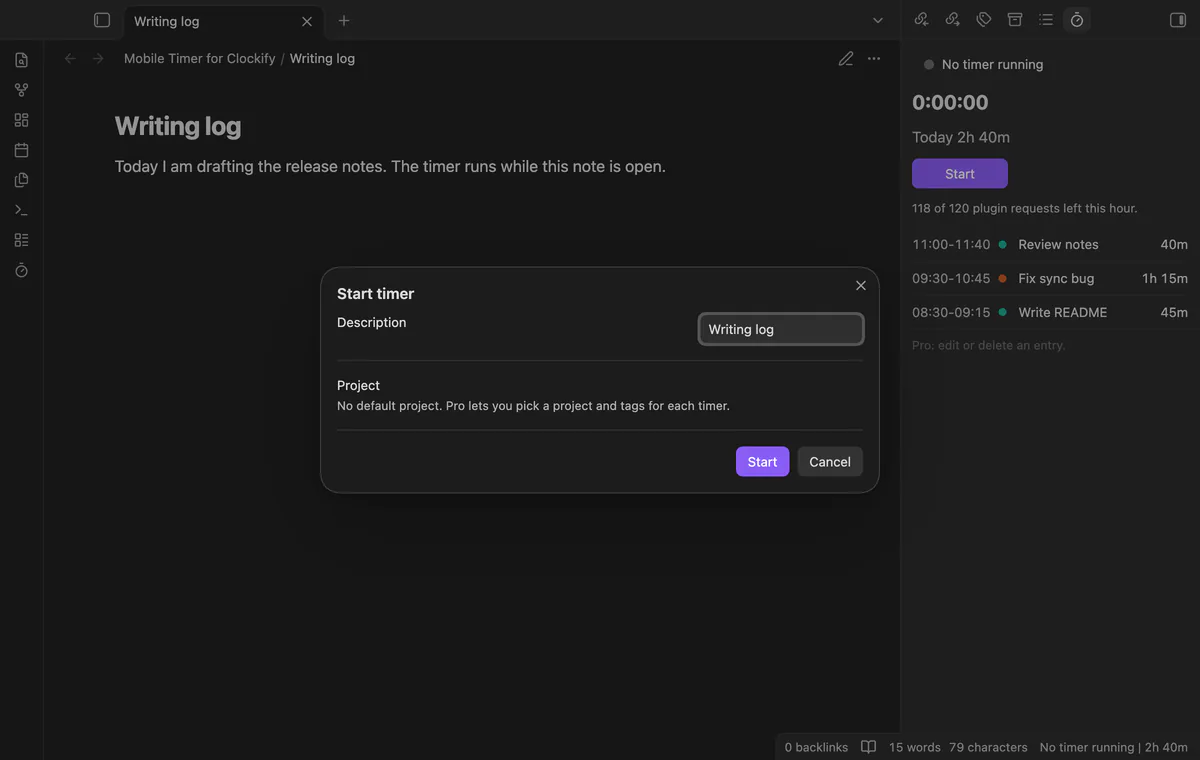
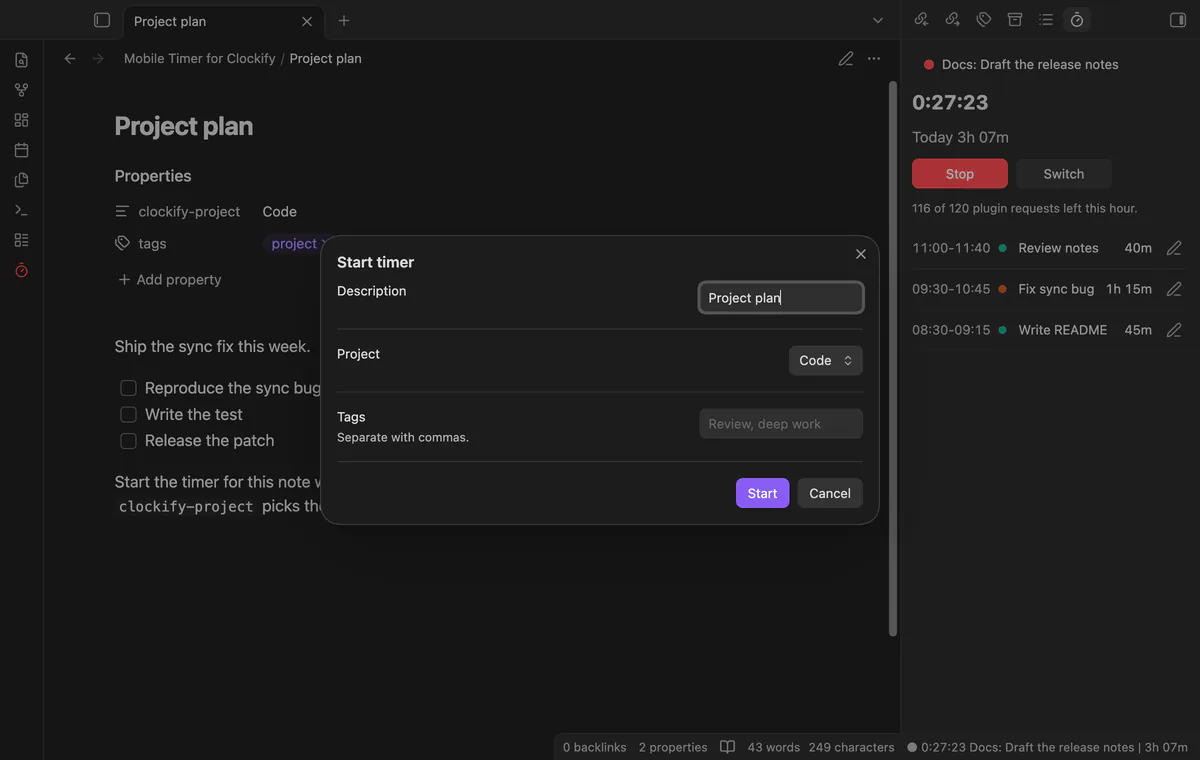
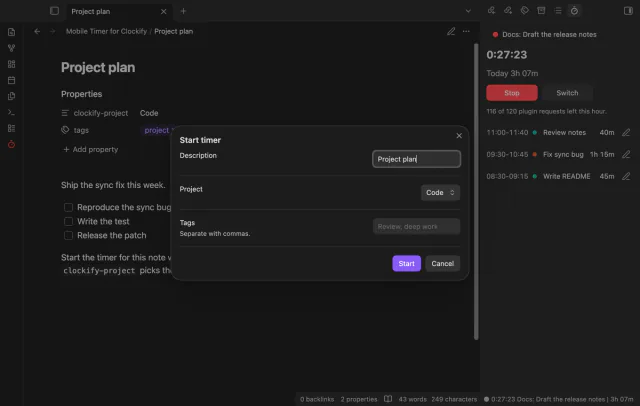
Run Start timer, and a window asks for a description and offers the name of the open note. Stop timer stops the running timer, and a start while a timer runs stops that timer first. Start timer for this note starts with no window and uses the default project from the settings.
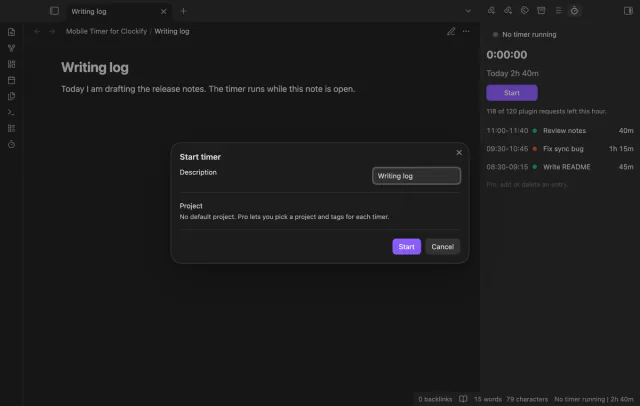
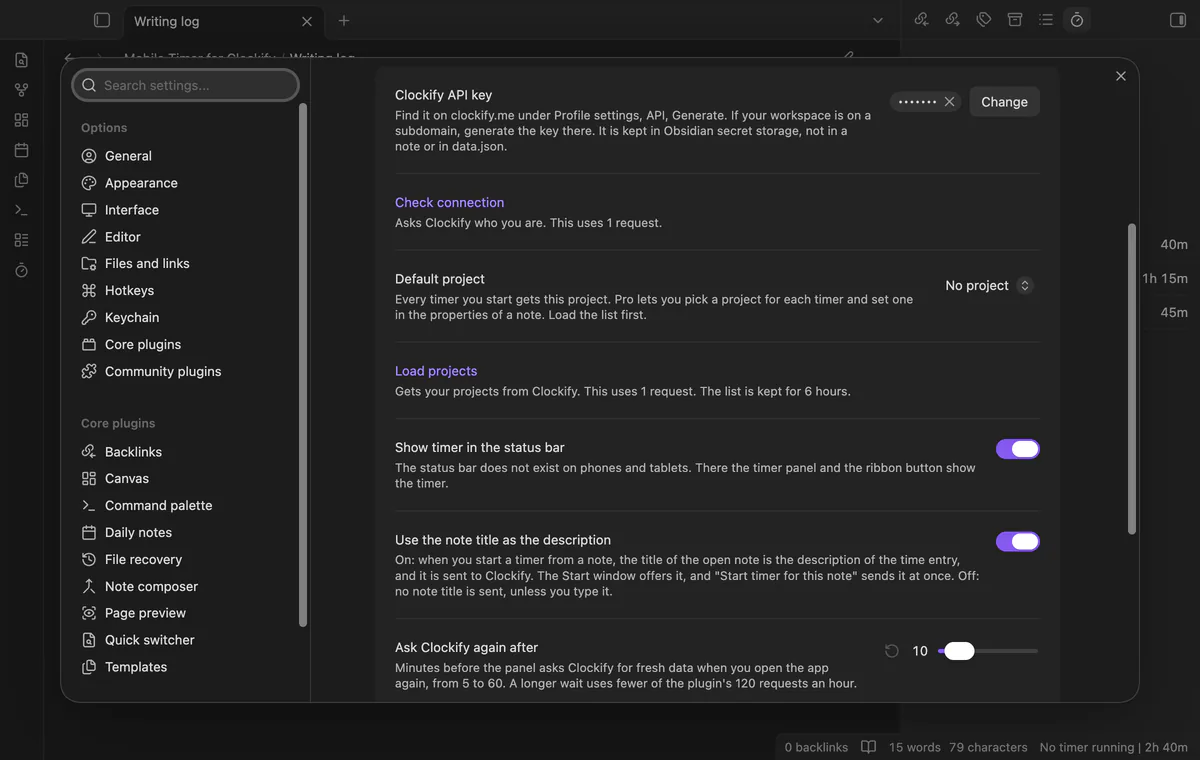
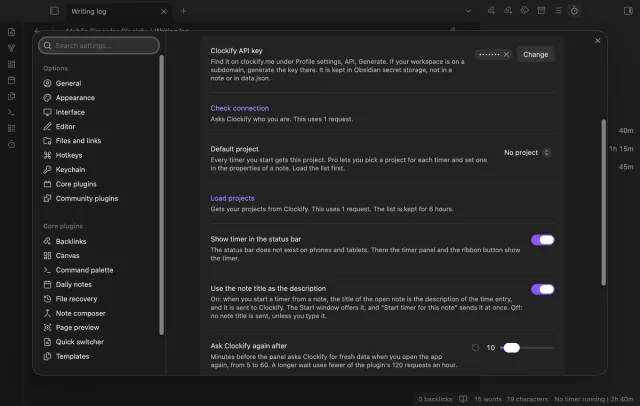
The setting Use the note title as the description is on by default. With it on, the name of the open note becomes the description of a new time entry, and Clockify receives it. With it off, the plugin sends no note name unless you type one.
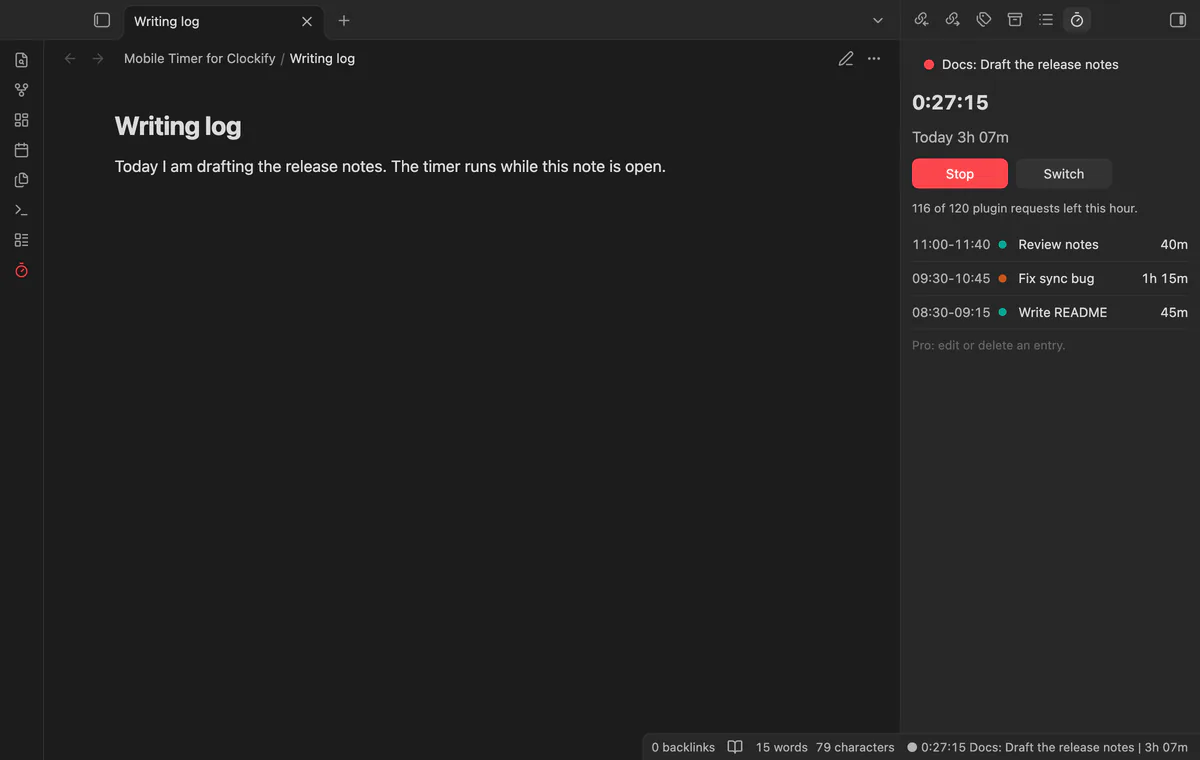
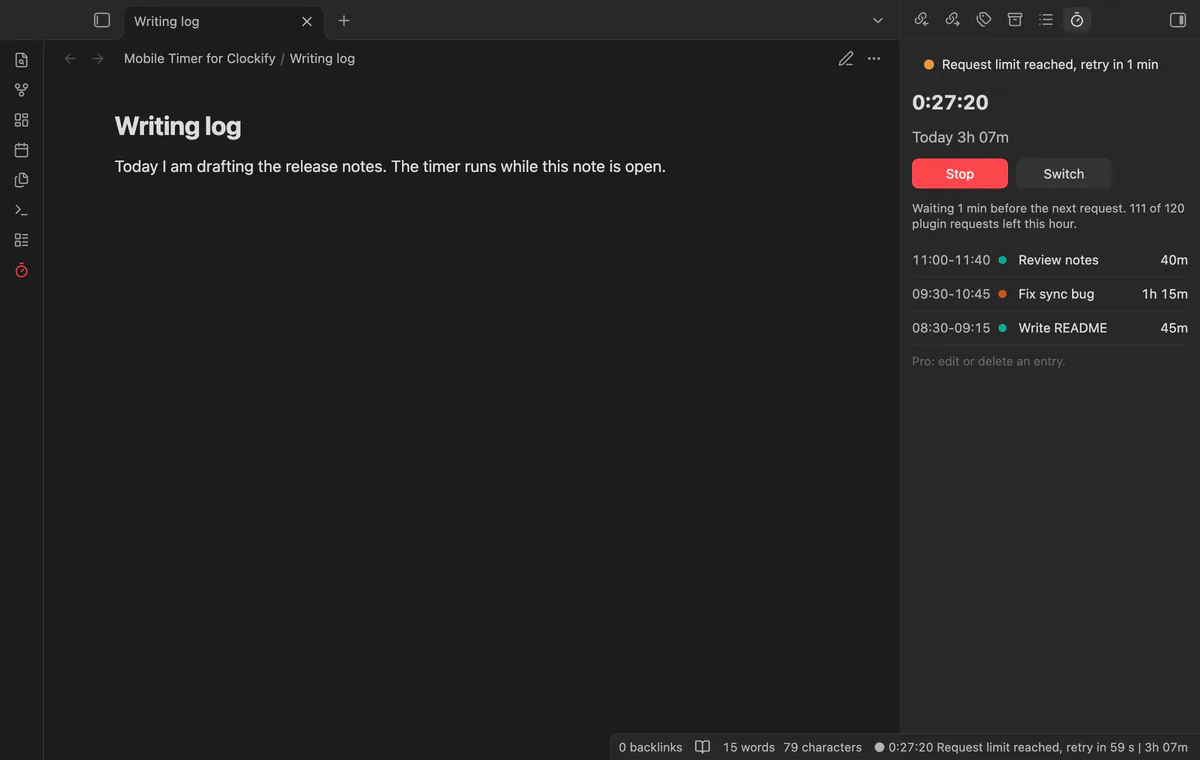
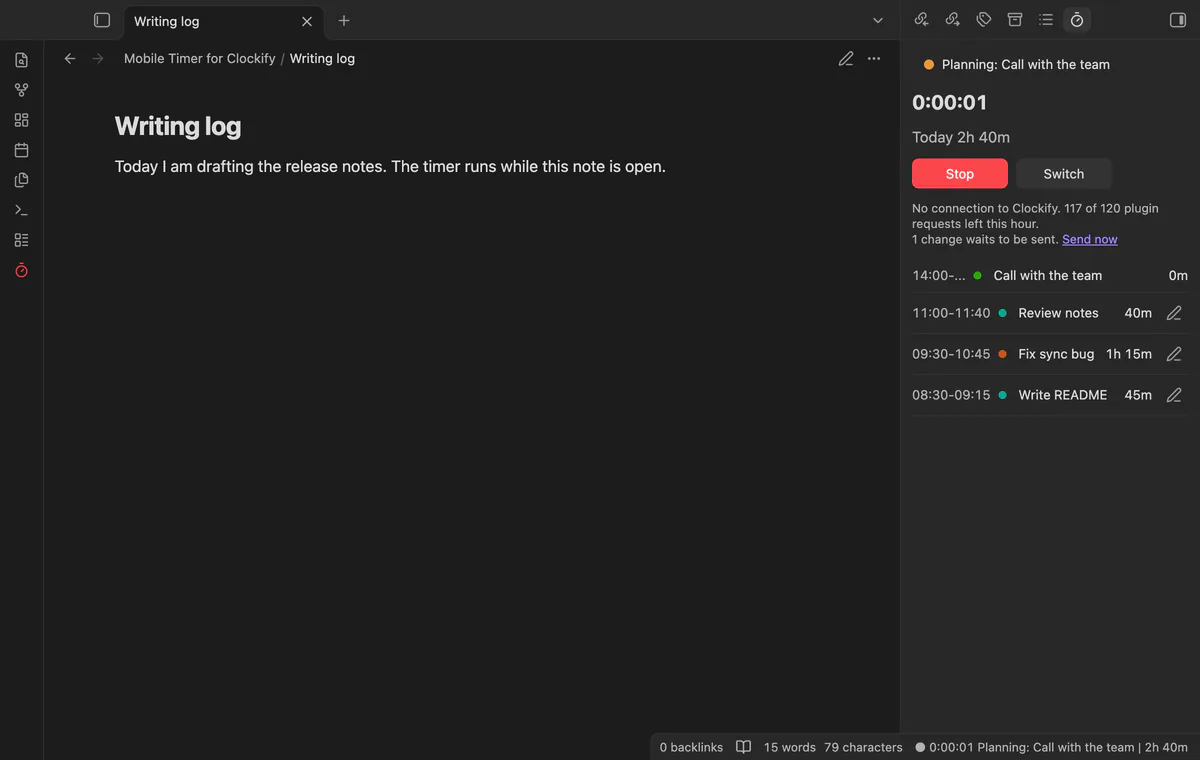
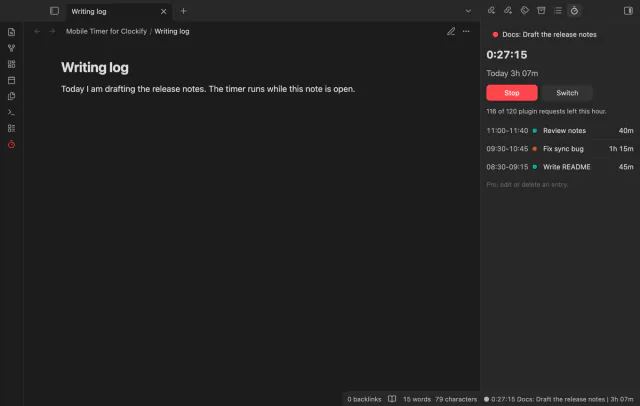
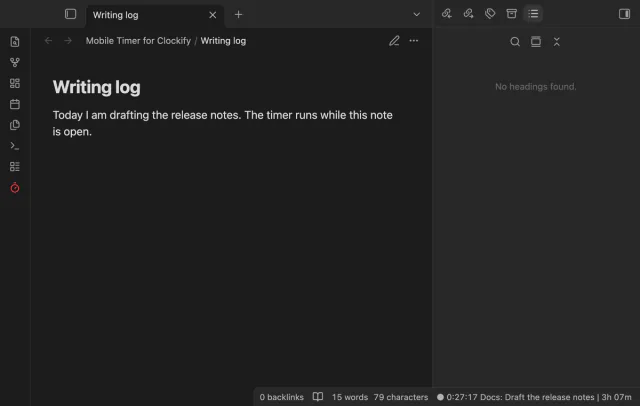
The command Open timer panel shows the running timer, its clock, today's total, the buttons and up to 25 finished entries of today. The ribbon button stops a running timer or opens the Start window, and it turns red while a timer runs. The clock counts from the start time that Clockify holds, so the plugin sends no request for it.
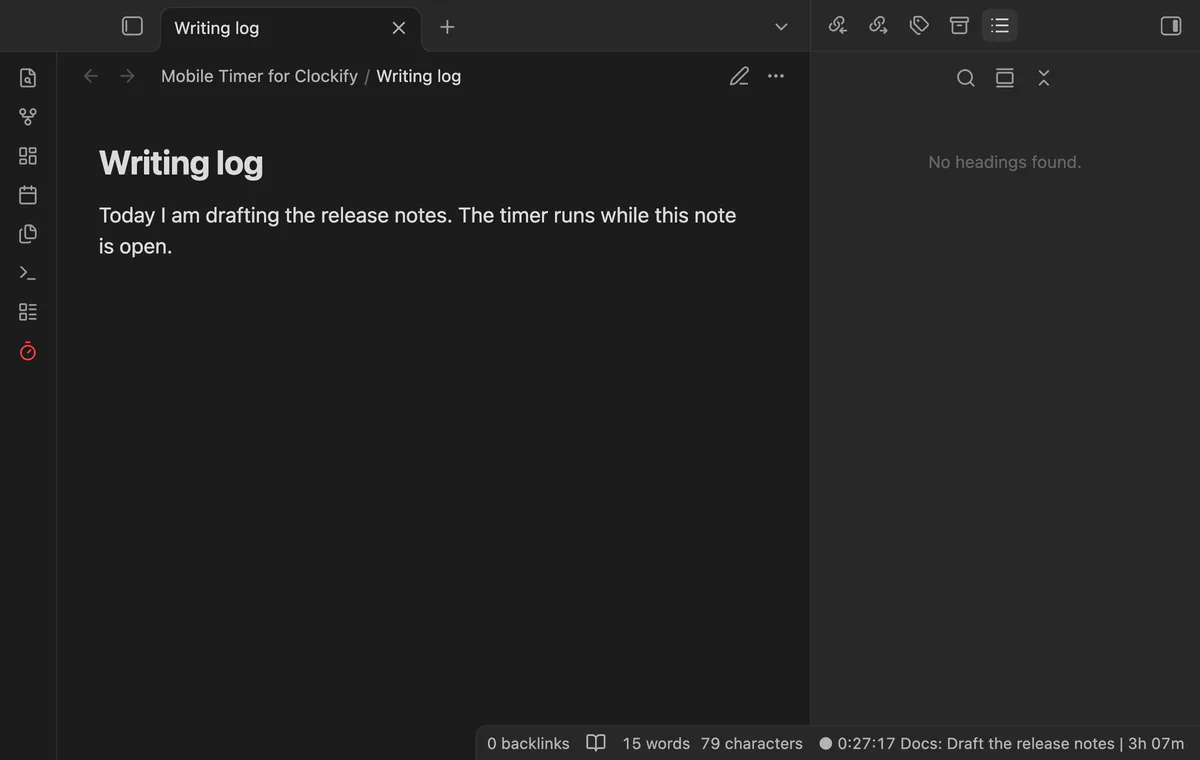
On desktop the status bar shows the clock, the project and description, and today's total. Select it to open the panel, or turn it off in the settings. The plugin adds no status bar item on mobile, where Obsidian does not support one.
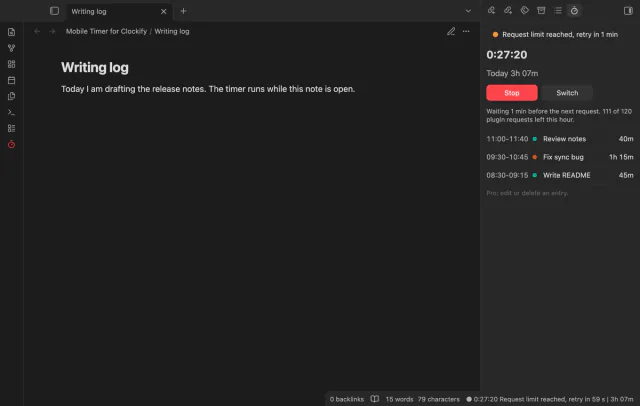
The plugin has a cap of 120 requests in a rolling hour, because the Clockify API docs name no limit for a personal key. Background refreshes stop when 8 requests are left, and your own actions can use the rest. After HTTP 429 the plugin follows the Retry-After header, or waits 1 minute, then longer, up to 20 minutes.
The free version gives each timer the one default project from the settings, and it has no pickers, reports, edits or queue.
Pro costs $5 a month or $15 one time through GitHub Sponsors. One sponsorship turns on Pro in every plugin that has it.
With Pro the Start window has a project list and a tags field for up to 10 tag names. A note can set its own project with a property named clockify-project, which holds the name of an active project. The property works after the plugin has loaded your project list, for example with Load projects in the settings.
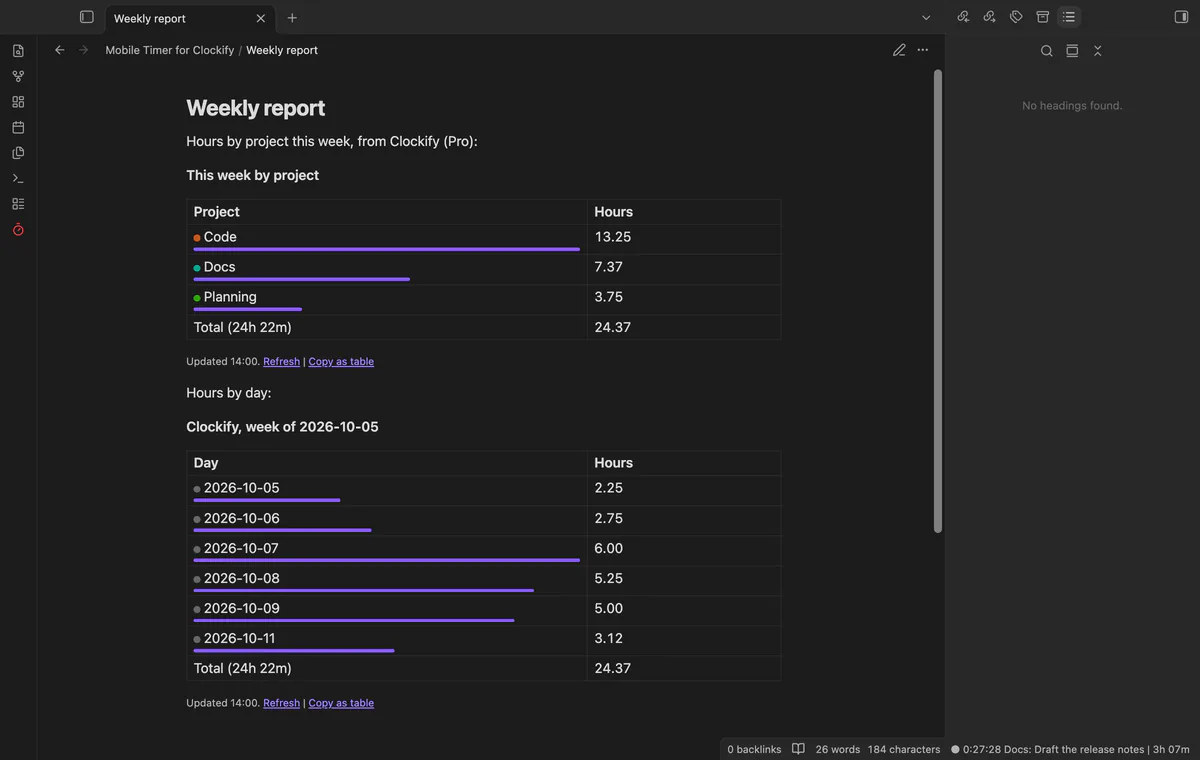
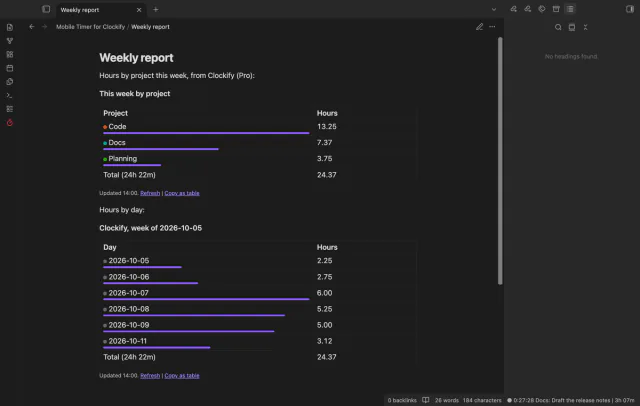
A clockify-report code block draws a table of hours by project, day or description. The range line takes today, yesterday, last7, week, month, or two dates up to 366 days apart. The plugin reads up to 500 entries in each request and keeps the answer for 15 minutes.
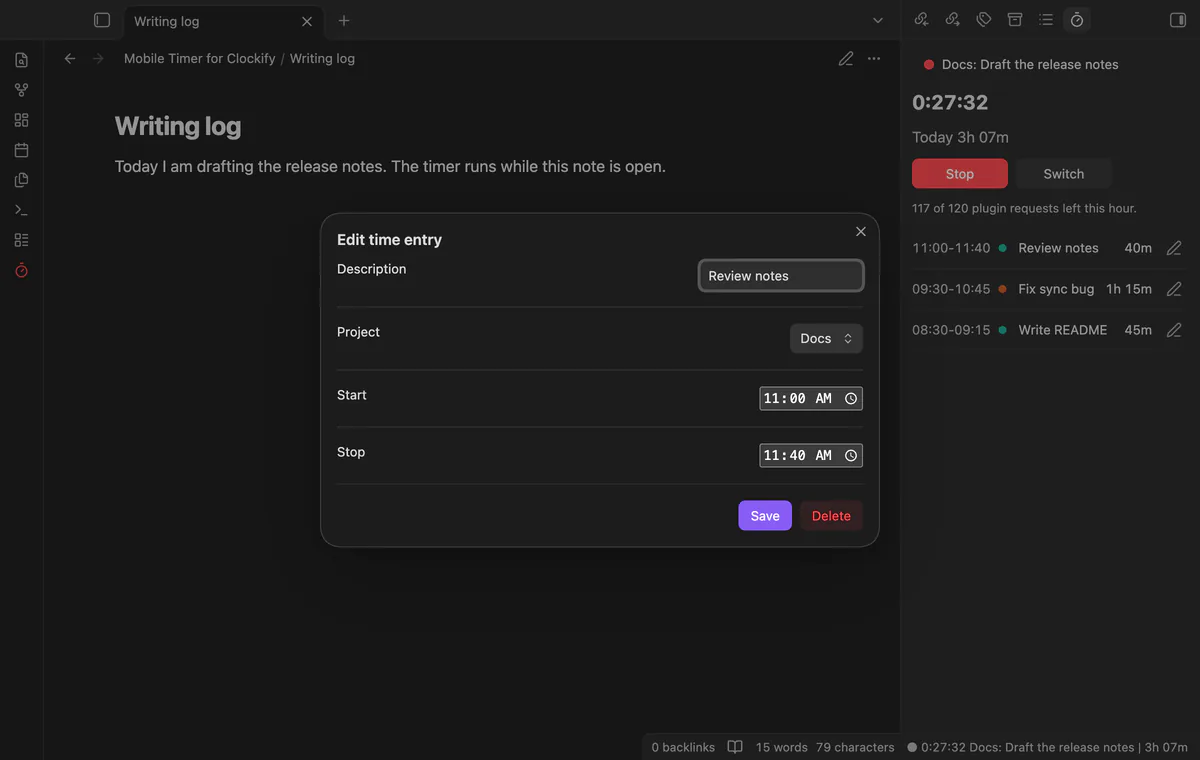
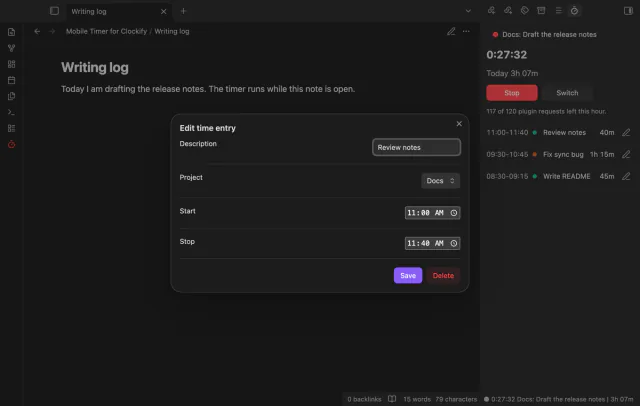
With Pro, each finished entry of today in the panel has an edit button. The window changes the description, the project, and the start and stop time, and it keeps the tags. Delete removes the entry from Clockify after a second selection.
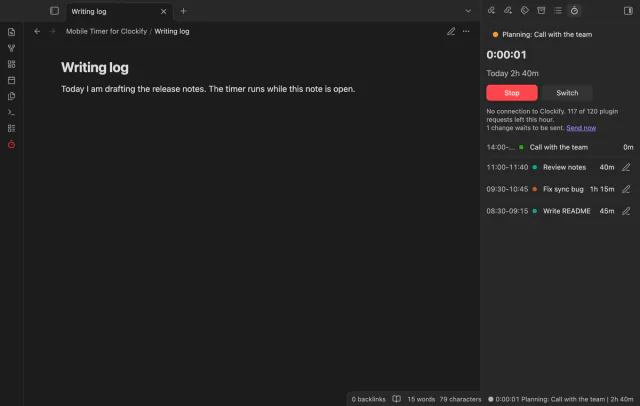
With no connection, a start or stop waits in a queue of up to 40 changes, and the panel shows the change. A start followed by a stop later goes out as one finished entry. Without Pro, such an action changes nothing, and a notice says so.
needs
api.clockify.me.steps
Install Mobile Timer for Clockify from Community plugins and enable it.
In Clockify, open your profile settings and generate an API key.
In the plugin settings, select the Clockify API key field, create a secret and paste the key.
Select Check connection. Select Load projects if you want a default project.
Open a note and run Start timer.
If the app can't find a new plugin yet, try again later. Obsidian says a plugin that passes the review shows in the app within 24 hours.
A search of the Obsidian community directory for Clockify found no other plugin on 11 October 2026. A search of the Obsidian forum found no post that names Clockify, so no request numbers exist for this plugin.
clockify-report block counts at most 1,000 time entries for its range and shows no notice when the range holds more.api.clockify.me, with no setting for another workspace or a regional address.The directory lists it for desktop and mobile, and the manifest allows mobile. The code uses the request function of Obsidian and no Node module, and it opens the panel in a tab on mobile. No test in the repository ran on a phone or tablet, so treat mobile use as untested.
Each request goes to api.clockify.me and carries your API key in a header. A start or an edit carries the description, project id, tag ids and times, and a stop carries the end time. The description is the name of the open note, unless you turn off Use the note title as the description. Requests go out when Obsidian loads or returns to the front, when you open the panel, and when you act.
The key is in the secret storage of Obsidian, and the file data.json holds only the name of that secret. The Obsidian developer docs say that a secret is kept in local storage for the vault. They also say that any plugin can reference a secret by its name. The file data.json does hold a copy of your recent time entries, projects and tags.
After HTTP 429 the plugin follows the Retry-After header, or waits 1 minute, then longer, up to 20 minutes. The panel shows that wait. At its own cap of 120 requests in a rolling hour, it sends nothing until an earlier request is an hour old. The panel and the settings show the requests that are left.
Sponsor on GitHub Sponsors for $5 a month or $15 one time, then select Sign in with GitHub in the settings. Pro stays on once GitHub reports $15 paid in total. After a successful check the plugin waits 7 days, and after a failed check it waits 6 hours.
With a saved API key, the plugin sends it to api.clockify.me when Obsidian loads or returns to the front and when you act. A new time entry carries the note name as its description, unless you turn off Use the note title as the description. After you select Sign in with GitHub, it also asks github.com and api.github.com about your sponsorship, 7 days after each successful check.
Mobile Timer for Clockify 1.0.1, MIT license
MIT · no telemetry · core features free
Start, stop and switch your Toggl Track timer from a note, and see today's total in Obsidian.
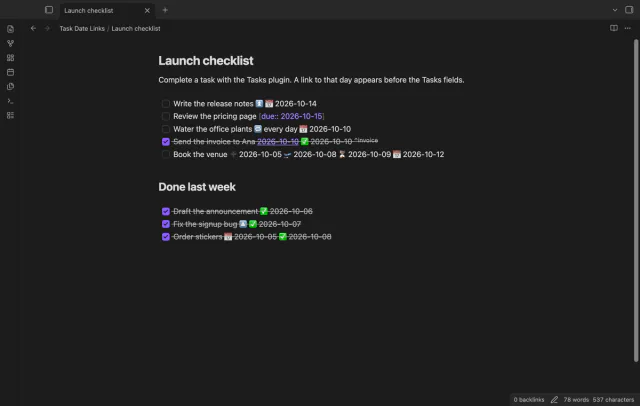
Complete a task and it links to that day, so the daily note lists it in its backlinks.
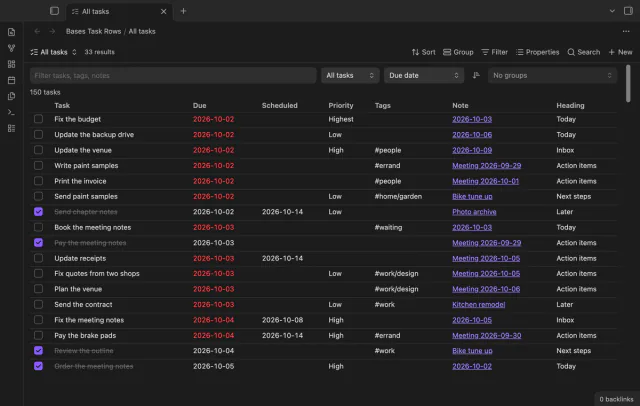
Every checklist task in the notes a base selects, one row each, with a done box you can tick.